
OnSite Learning Center
A Learning and Application Platform for Autonomous-Driving Datasets
OnSite Learning Center is a comprehensive platform for learning, exchanging knowledge, and sharing resources in autonomous-driving technology. It organizes learning resources—including datasets, example models, Benchmark Models, and Leaderboards—around research problems and specific tasks, helping learners build a systematic understanding of autonomous driving. The platform provides tailored services for users at different levels: helping beginners get started quickly, supporting advanced learners in deeper study, encouraging algorithm developers to participate in Co-build and Share, and fostering a well-rounded autonomous-driving learning community.
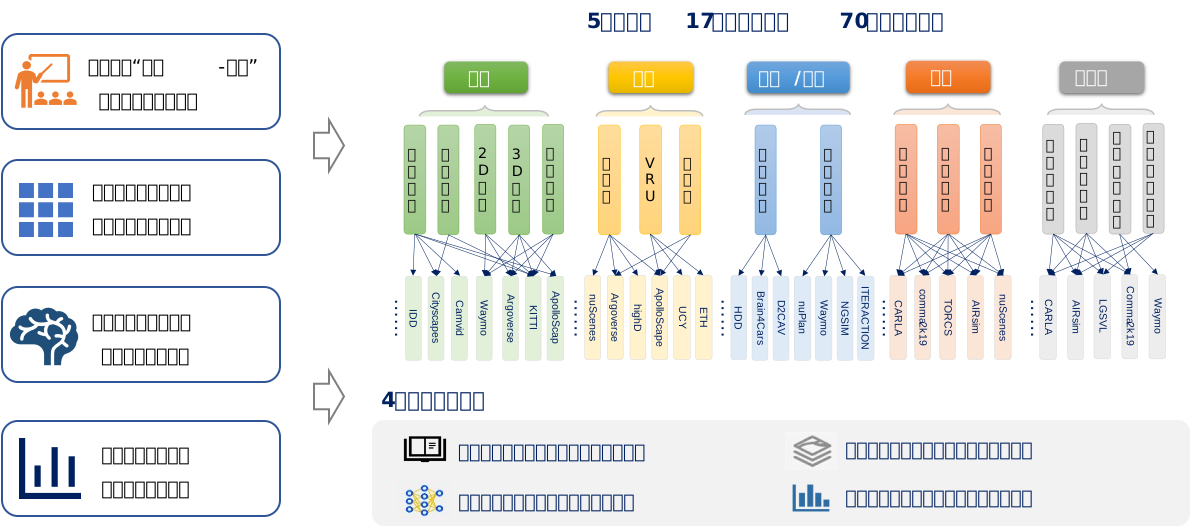
OnSite Learning Center organizes its resources through the pathway “problem–task–dataset–example model–Benchmark Models–Leaderboard.” Problems, tasks, datasets, and example models introduce foundational theory and help beginners implement basic models; Benchmark Models, contributed by algorithm developers, support more advanced learning; and Leaderboards encourage iterative improvement of autonomous-driving algorithms. With tiered and personalized services, the platform enables efficient learning and supports both autonomous-driving education and algorithm development.
Understand the technical landscape and get started with example models
- The OnSite Learning Center providesBeginner Learnerswith curated learning resources, including introductions to core concepts and hands-on sample code.
- InQuick Start, you can access these resources. For the five problem areas of perception, prediction, decision and planning, control, and end-to-end learning, we provide problem and task descriptions as well as step-by-step tutorials for mainstream foundational research models. Learners can deepen their understanding of theory through hands-on practice after mastering the basics.
Online Coding Practice Guide
To lower the barrier to learning, the OnSite Learning Center provides acloud-based code practice environment, built on JetBrains Datalore and supporting interactive Notebook learning in Python. You can read learning documents online and run code directly without configuring a local environment:
- How to run online:
- Click “Run Code Online” in a course to open its shared Datalore project.
- Sign in or register with a Google email or JetBrains account (Register here)
- Click “Copy to Private Workspace” to copy the project to your own workspace.
- Run code block by block in your private Notebook, or execute the full workflow at once.
- Notes:
- Shared projects are view-only; copy a project to your private workspace before editing.
- Notebooks combine explanatory text and code modules and support interactive debugging.
- For local execution, configure a Conda environment in PyCharm (see the instructions in each project).
Learn benchmark models and use the resource library
- The OnSite Learning Center also providesAdvanced Learnerswith rich learning resources. After mastering the fundamentals, users can visitBenchmark Modelsfor more advanced algorithm models, or use the Resource Library to learn more aboutDatasetsandutility functions.
- Benchmark Models provide learners with a structured and standardized resource library. They bring together the latest research results and allow learners to contribute their own models through collaborative development. For each task, the OnSite Learning Center defines a systematic workflow so learners can get started efficiently.
- The Resource Library collects datasets, utility functions, development templates, and other resources, helping learners broaden their perspective and deepen their understanding of autonomous driving tasks.
Develop benchmark models and join the leaderboards
- The OnSite Learning Center encourages everyAlgorithm Developersto contribute to OnSite through collaborative development and sharing, including joining leaderboards for research problems and tasks and participating in community discussions.
- By visitingLeaderboard, experts can clearly understand the current state of models for each research task. Models on the leaderboards may be included as benchmark models for other learners.
- InRecommended Templatespages provide a file structure for each problem and task, helping beginning learners compare models and transfer methods within the same task.
Join the community and co-build
- We encourage all users to contribute by sharing problems, tasks, datasets, or models discovered through research and practice with the OnSite Learning Center. Whether you have found a new dataset, implemented a state-of-the-art model, or encountered a technical challenge worth discussing, you can submit your contribution through the platform. The Learning Center encourages collaborative development and sharing, including participation in leaderboards and community discussions for different research problems and tasks.