
Prediction - Multi-Vehicle Trajectory Prediction
The project introduces an enhanced Tukey interactive perception trajectory prediction model called GRIP, aiming to improve the safety of autonomous vehicles in urban traffic environments. The download link for the complete project is:https://github.com/TOPSlearningcenter/Trajectory_prediction_multi
Model Overview
1. Model overview:
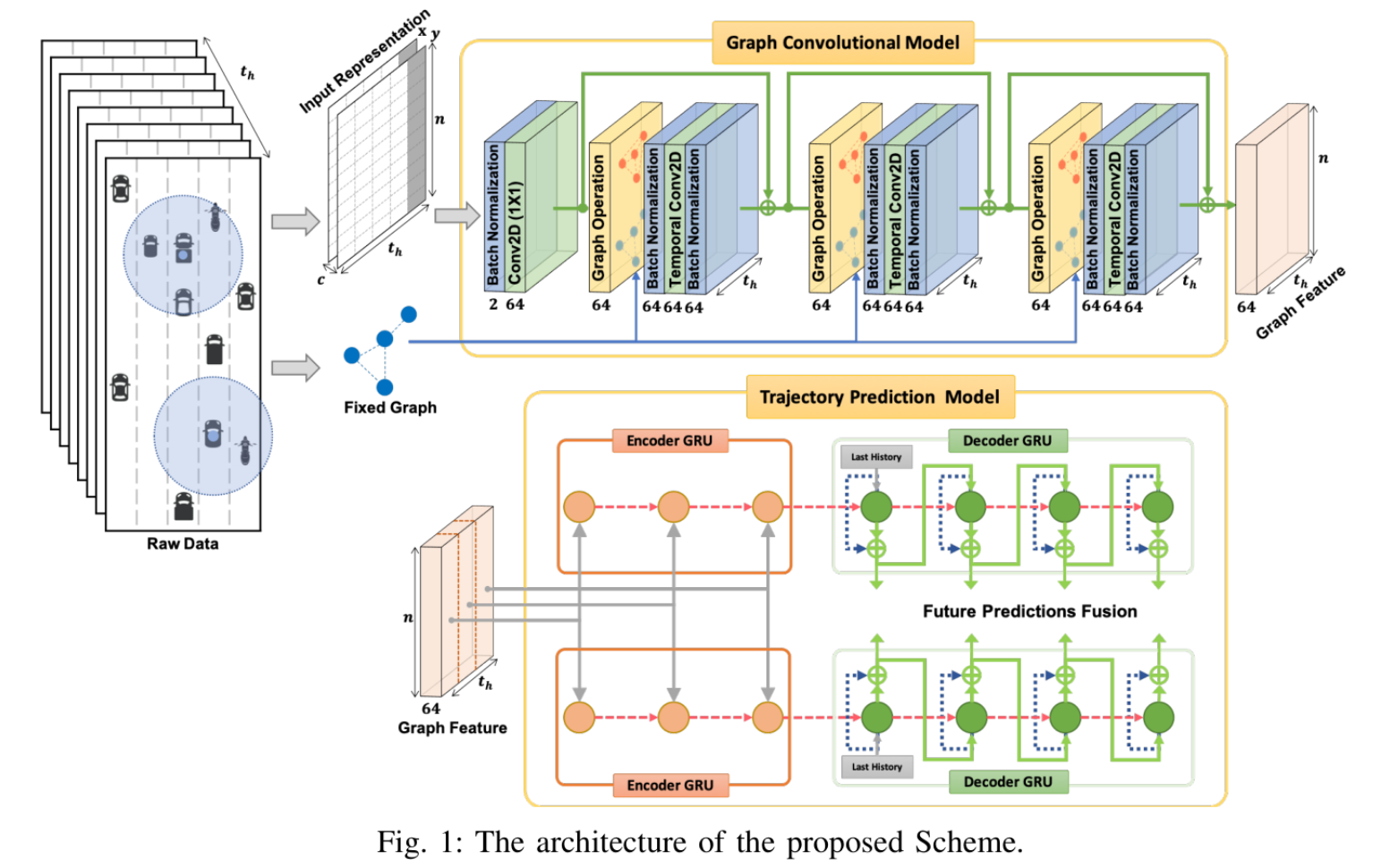
- Research background: The safety issue of autonomous vehicles is still a challenge, especially motion prediction, which is one of the core functions of autonomous driving and is crucial to improving safety.
- GRIP target: An improved scheme is proposed to predict the trajectories of different types of traffic participants (such as vehicles, pedestrians, bicycles, etc.) using fixed and dynamic graphs to improve prediction accuracy and help avoid traffic accidents.
- Performance: Evaluation on the ApolloScape urban traffic dataset shows that GRIP outperforms existing schemes in prediction accuracy and ranked first in the ApolloScape trajectory competition in October 2019.
2. Model Architecture:
- Input preprocessing model: Convert the original trajectory data into a specific format to facilitate subsequent calculations, and calculate the speed for model prediction.
- Graph convolution model: Increase the number of channels through 2D convolutional layers, and then process the input data alternately through multiple graph operation layers and temporal convolutional layers to capture the spatial interaction and temporal dynamic characteristics between objects.
- trajectory prediction model: Adopt multiple Seq2Seq network structures, each network contains encoder and decoder GRU networks, input graph feature vectors and predict future location coordinates.
3. Implementation:
- Datasets: Evaluation using the ApolloScape trajectory dataset, which contains vehicle trajectory information under different traffic conditions.
- Performance indicators: Use metrics such as root mean square error (RMSE) and weighted average displacement error (WSADE) to evaluate the prediction performance of the model.
- optimization: Use the Adam optimizer for training, treat the model as a regression task, and minimize the loss function.
- Experimental results: GRIP outperforms existing schemes on multiple datasets, especially in urban traffic scenarios, showing higher accuracy and faster running speed.
- Visualization: By visualizing the prediction results, it demonstrates GRIP’s prediction capabilities under different traffic conditions, including straight and curved scenes.
Overall, GRIP++ combines static and dynamic graphs with an efficient encoder-decoder architecture to improve trajectory prediction for autonomous vehicles in complex urban environments, which is important for increasing safety and reliability.
4. Main Workflow:
- Environment Setup
- Data Preprocessing
- Model Training
- Model Evaluation
- Selected Scenario Visualization